
If you have ever worked with LED video walls, digital billboards, or indoor LED displays, you have probably heard the terms LED sending card and LED receiving card many times. They often come up during installation, troubleshooting, or upgrades. Yet for many people, their exact roles remain unclear.
The whole LED system runs well because of these two parts. In a properly configured LED system, sending and receiving cards operate invisibly in the background. When either one fails, the result is immediate and noticeable, partial panel dropout, frozen frames, color distortion, or complete signal loss across sections of the wall.
Knowing the difference between LED sending cards and LED receiving cards will help you make better choices when you build, take care of, or add to an LED show. Let’s explain it in a simple way, using no difficult words.
What Are LED Sending Cards and LED Receiving Cards?
In every LED display system, video data must travel from a source to the screen. That source could be a laptop, a media player, a video processor, or a control computer. The data does not go directly to the LED panels. Instead, it passes through two critical devices.
Think of the system as a delivery process:
- The LED sending card is the dispatcher.
- At the end point, the LED receiver card works as a translator.
Both are required. One cannot function without the other.
LED Sending Cards: What They Do and Why They Matter
The LED transmitter card sends video data from the source to the LED display device. It gets the input, works on it, and gets it ready to be shown on the screen.
How an LED Sending Card Works
The sending card receives video through HDMI, DVI, or DisplayPort connections. It then formats that data so the LED system can understand it. From there, the signal is transmitted to one or more receiving cards through Ethernet cables.
Benefits of LED Sending Cards
LED sending cards are essential because they:
- Manage the overall image displayed on the screen
- Support high-resolution video sources
- Ensure proper synchronization across the display
- Allow configuration and adjustment of screen settings
- Enable communication between the control system and LED panels
Without a reliable sending card, even the best LED panels cannot display content correctly.

Why LED Sending Cards Are Useful
Sending cards are ideal for environments where content changes frequently or must remain synchronized across large display areas. People often use them in these situations:
- Concert LED walls with live video feeds
- Event stages with real-time effects
- Digital signage systems with scheduled content
- Corporate displays requiring precise resolution control
In most systems, only one or two sending cards are needed, depending on the size and resolution of the display.
LED Receiving Cards: What They Do and Why They Matter
An LED receiving card lives inside each LED cabinet or module. Its job is to receive the data sent by the sending card and convert it into instructions for the LEDs.
How an LED Receiving Card Works
Each receiver card is in charge of a certain part of the show. It unpacks the incoming information and tells each LED when to change, what color to show, and how bright to be.
Multiple receiving cards work together to create a single, seamless image across the entire screen.
Benefits of LED Receiving Cards
Receiving cards are critical because they:
- Manage the operation of every single LED on each panel.
- Maintain the brightness and color uniformity.
- Ensure that the pixels are aligned across all screens.
- Enable high refresh rates to ensure smooth visuals.
- Enable calibration for uniform image quality
If a receiving card fails, the affected panel may flicker, show incorrect colors, or stop working entirely.
Why LED Receiving Cards Are Useful
Receiving cards make large LED displays possible by allowing each cabinet to process and display its assigned portion of the image. They allow massive screens to function as one image rather than separate panels. They are essential in:
- Retail store LED walls
- Church and conference displays
- Outdoor LED billboards
- Control rooms and studios
Every LED panel requires its own receiving card, which makes these components a key part of system scalability.
Key Differences Between LED Sending Cards and LED Receiving Cards
While they work together, their roles are very different.
Location
- Sending cards are installed in the control system or rack.
- Receiving cards are installed inside LED panels or cabinets.
Primary Function
- Sending cards manage the entire screen image.
- Receiving cards control specific portions of the display.
Data Flow
- Sending cards transmit data outward.
- Receiving cards receive, decode, and execute that data.
Quantity Used
- Typically one or two sending cards per setup.
- One receiving card per LED panel or module.
Connections
- Sending cards connect to video sources and Ethernet outputs.
- Receiving cards connect via Ethernet to other panels and modules.
Together, they form the backbone of any LED display system.

Are There Different Types of LED Sending and Receiving Cards?
Yes. Both sending and receiving cards come in many models. The right choice depends on your system requirements.
Factors to consider include:
- Maximum supported resolution
- Number of Ethernet ports
- Refresh rate capabilities
- Latency performance
- Compatibility with LED controllers
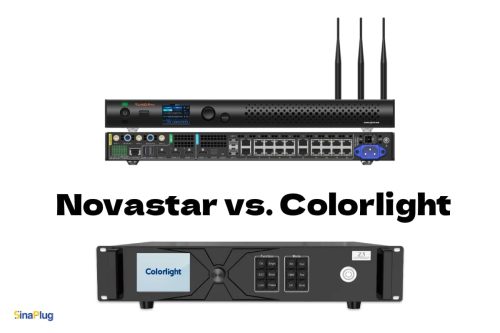
- Support for brands like NovaStar and Colorlight
Choosing the wrong card can limit performance or cause compatibility issues. That’s why selecting the correct combination is so important.
Why Understanding the Difference Matters
Knowing the difference between LED sending cards and LED receiving cards helps you:
- Design better LED display systems
- Troubleshoot issues more effectively
- Avoid replacing components unnecessarily by accurately identifying whether the issue originates from the sending card, receiving card, or upstream signal source.
- Scale screens with no drop in performance
- From the beginning, pick tools that will work together.
Installers, techs, and business owners save time and money when they know this.
How SinaPlug Helps
At SinaPlug, knowledgeable professionals are ready to assist you every day. Our selection includes an extensive array of LED sending cards, receiving cards, and controllers compatible with various LED devices.
We help customers:
- Choose the right card combinations
- Match cards with LED panels and LED processors
- Upgrade systems safely
- Replace faulty components quickly
When constructing a new LED wall or enhancing an existing display, proper guidance simplifies the process.
Conclusion
LED sending cards and LED receiving cards may not be visible to the audience, but they are the heartbeat of every LED display system. One manages the big picture. The other handles the fine details. Together, they turn raw video signals into bright, seamless visuals.
Understanding the difference between these two components allows you to build stronger, more reliable LED systems. When both cards are properly selected and configured, your display performs at its best.
If you need help choosing the right LED sending card and receiving card combination, SinaPlug is ready to help.
Contact SinaPlug today for expert guidance and trusted LED display components that keep your visuals sharp, stable, and professional.